Different from your real age
Your heart age
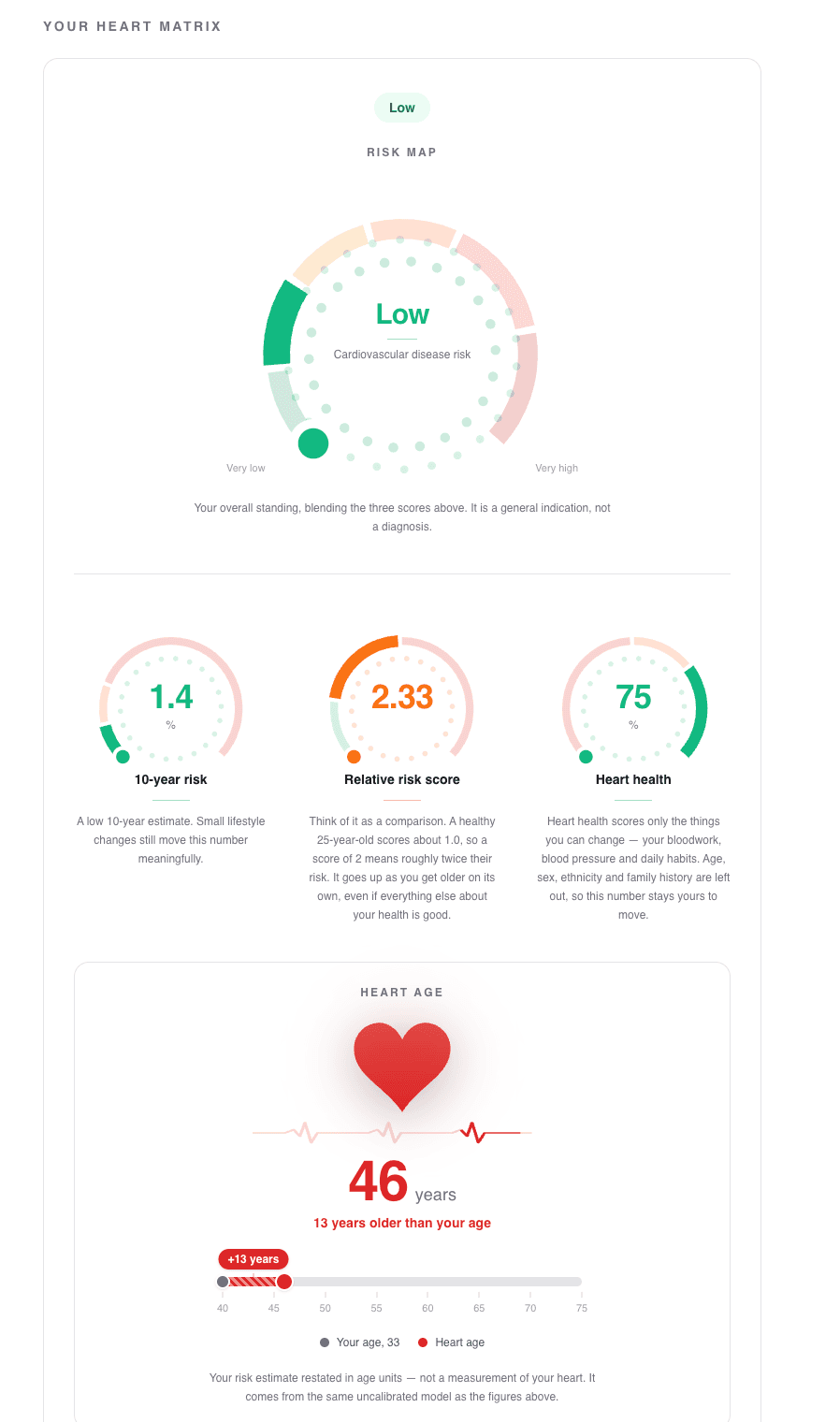
The age of a person whose heart carries the same risk as yours. It is not your biological age and not your age in years — a 40-year-old can have the heart of a 52-year-old, or a 33-year-old.
It is rarely the same as the age on your passport. Answer a few questions about your body, bloodwork and daily habits, and find out how old your heart really is — and what to do about it.
About three minutes. Your answers are saved, so you can finish later.
Illustrative figures. Your report is built entirely from your own answers.
Peer-reviewed foundations
Heart Score does not invent a scoring method. It follows the same proportional-hazards approach as these published, peer-reviewed models.
Framingham Risk Score
Framingham Heart Study, running since 1948
SCORE2 / SCORE2-OP
European Society of Cardiology
WHO / ISH charts
World Health Organization & International Society of Hypertension
Pooled Cohort Equations
American College of Cardiology / American Heart Association
QRISK3
ClinRisk & the University of Nottingham, used across the NHS
Heart Score follows the same family of method as these models. It is not one of them, and it is not endorsed by the institutions that publish them.
The stakes
Heart disease is the leading cause of death in the world — and the most preventable.
17.9M
deaths a year
More than any other cause, worldwide.
32%
of all deaths
Nearly one in three deaths globally.
85%
are heart attack or stroke
Events that often arrive without warning.
Most
are preventable
Driven by risk factors you can act on.
Figures: World Health Organization.
3 in 4
deaths outside rich countries
More than three quarters of cardiovascular deaths happen in low- and middle-income countries.
10 yrs
earlier in South Asians
South Asians tend to develop heart disease around a decade earlier than Western populations.
90%
of first heart attacks
Nine modifiable risk factors accounted for over 90% of the risk in the INTERHEART study.
1 in 2
had no warning
For around half of sudden coronary deaths, there were no prior symptoms at all.
Figures: World Health Organization; INTERHEART study (The Lancet, 2004); American Heart Association; Indian cardiovascular registries.
Your report
Four answers, in plain language, from one set of questions.
The age of a person whose heart carries the same risk as yours. It is not your biological age and not your age in years — a 40-year-old can have the heart of a 52-year-old, or a 33-year-old.
The estimated chance of a heart attack, stroke or other cardiovascular event in the next ten years, given everything you told us — shown as a percentage you can actually act on.
A single figure out of 100 for how well your heart is doing right now, built from your blood pressure, lipids, metabolic markers, fitness and habits. It scores only what you can change.
Every answer is scored and shown back to you, so you can see which factors are pushing your risk up — and which changes would bring it down the most.
Three different ages
The two get used interchangeably, and they are not the same thing. Here is what each one actually answers.
The number of years since you were born. It is fixed, it moves at exactly one year per year, and nothing you do changes it.
Answers: how long have I been alive?
A broad estimate of how your whole body is ageing — cells, organs and systems together, usually from a wide panel of markers. Useful, but general.
Answers: how is my whole body ageing?
The age of a person whose cardiovascular risk matches yours. Narrow, specific, and the one that tells you whether your arteries are running ahead of or behind your birthday.
Answers: how old is my cardiovascular system?
The process
Three steps. You can stop at any point and pick up where you left off.
Start with the basics — sex, age, height, weight, blood pressure. Every step is saved as you go.
Have recent bloodwork, a calcium score or a smartwatch? Add it and the estimate sharpens. Skip anything you do not have.
Your heart age, 10-year risk, health score and a breakdown of every factor behind them.
What we ask
Fourteen essentials get you a result. Everything else is optional and makes the estimate sharper.
Sex · Age · Ethnicity · Height · Weight · Waist · Blood pressure
Steps · Training · Sitting time · Movement breaks · Screen time · Sleep habits · Diet · Smoking · Alcohol · Stress
Triglycerides · HDL · LDL · Total cholesterol · VLDL · ApoB
HbA1c · Fasting glucose · Fasting insulin · Uric acid · TSH
Lp(a) · hs-CRP · Homocysteine · Lp-PLA2
VO₂ max · Resting heart rate · HRV · Coronary calcium score · Family history
Fourteen essentials are enough for a full result. The other 23 are optional.
Under the hood
Heart Score uses a proportional-hazards model — the same family of method behind the Framingham risk score, SCORE2, the WHO cardiovascular risk charts, the ACC/AHA Pooled Cohort Equations and QRISK3. Your answers become risk multipliers, grouped by domain so related factors do not double-count, and applied to a baseline survival curve for your age and sex. Heart age is read back off that same curve: the age at which your risk would be average.
This is an educational estimate, not a diagnosis, and not a medical device. It is built on published, peer-reviewed methods, but it is not endorsed by any of the institutions behind them, and the model is not calibrated against a specific population cohort. Treat the figures as a well-reasoned indication rather than a clinical measurement. It does not replace a proper risk assessment with a doctor.
Proportional hazards, the approach used by Framingham, SCORE2 and the WHO risk charts.
Related markers are grouped by domain, so five lipid values do not stack into five separate penalties.
A coronary calcium score, where you have one, reclassifies the estimate rather than nudging it.
Every factor that moved your number is shown back to you, with the direction it pushed.
FAQ
No. Biological age tries to describe how your whole body is ageing. Heart age is narrower and more specific: the age of someone whose cardiovascular risk matches yours. You can have a young heart age and an older biological age, or the reverse.
You can still get a result. Fourteen essentials — things you already know, like age, height, weight, blood pressure and habits — are enough. Bloodwork, a calcium score and wearable data are optional and only sharpen the estimate.
It is an estimate built on an established method, not a clinical measurement. The model is uncalibrated, so it is best read as a direction and a rough magnitude — useful for deciding what to change and what to discuss with a doctor.
They are saved to your account so you can leave and come back, and so your past reports stay available. They are not shown to anyone else.
Yes. Change a value and you get a fresh report, and your earlier ones stay in My Report so you can watch the trend over time.
Answering the questions is free and your progress is saved as you go. Unlocking your full report — heart age, 10-year risk, heart health score and the factor-by-factor breakdown — is a one-time payment of ₹99. There is no subscription.
Three minutes now for a number worth knowing.
Answering is free. Unlock the full report once for ₹99 — no subscription.
Heart Score is an educational estimate, not a diagnosis, and is not a medical device. It is not endorsed by the World Health Organization or any other institution whose published methods it draws on, and the model is not calibrated against a specific population cohort. It does not replace a clinical cardiovascular risk assessment — discuss any concerns with a qualified clinician. If you have symptoms such as chest pain or breathlessness, seek medical help now.